VERIFITECH – Background Verification Company

Global Redirect Menu

Case Studies

Case Studies

A Small Pillow in the Washroom. A Big Workplace Risk Nobody Expected. 

A Small Pillow in the Washroom. A Big Workplace Risk Nobody Expected. When Small Suspicion Became a Serious Workplace Safety Concern   Everyday invest in CCTV, access control, cybersecurity and employee wellbeing. But sometimes, the biggest risk enters quietly. Not through the front gate. Not through a cyberattack. But through people. Recently, news across Tamil Nadu has been dominated by large-scale drug seizures. In Chennai suburbs, Avadi and Thiruvallur police seized nearly 140 kilograms of ganja, arresting multiple suspects. In Nanguneri, authorities destroyed 1 ton of seized ganja worth around ₹5 crore under legal supervision. Meanwhile Chennai City Police intensified crackdowns, seizing ganja and illicit prescription drugs during surprise enforcement drives. The message is becoming impossible to ignore: Substance abuse is no longer someone else’s problem. It is moving closer to workplaces than many organizations realize. And one company learned this the hard way. The Call That Started It All   A client approached us with concern. Not panic. Not accusations. Just concern. An internal employee — let’s call him “Person X” — had shared photographs from inside the workplace. At first glance, the images looked unusual. Small pillow-like packets. Suspicious material. Some were reportedly found near the washroom area. Others appeared within workspace corners. Nobody knew what it was and wanted to jump to conclusions. But one uncomfortable question started circulating internally: “Could this be drugs?” The management faced a difficult challenge. If they ignored it, workplace safety could be compromised. If they accused someone without evidence, it could destroy trust of the organization to legal complications. Suspicion is not proof. And assumptions can be dangerous. The Real Workplace Challenge: You Cannot Suspect Everyone   The leadership team faced a serious dilemma. Who could be responsible? Was it one employee? An outsider? A small group? Or simply a misunderstanding? The harder reality was this: When there is no evidence, everyone becomes a suspect — and that is dangerous for workplace culture. The company did not want a witch hunt. They wanted clarity. Facts. Evidence. A legally defensible process. That is when they consulted us. Our Recommendation: Stop Guessing. Start Verifying.   After understanding the complescenariote , we recommended a structured and neutral approach: Workplace Drug Screening Program   Instead of targeting individuals based on assumptions, we suggested: A controlled drug screening initiative A standardized testing process Equal and fair treatment for employees Evidence-based decision-making Compliance-driven reporting The approach was simple: Do not accuse. Verify. Rather than asking: “Who do we suspect?” We changed the question to: “What do the facts reveal?” The Outcome: Facts Replaced Fear  The company proceeded with testing. And the results revealed something management had feared — but needed certainty about. A small group of individuals were identified to be involved in the substance related activities. Appropriate internal disciplinary action was taken based on company policy according to compliance procedures. More importantly: The organization prevented a much larger workplace risk before it escalated. Because workplace substance misuse does not stop at individual behavior. It impacts: Employee safety Productivity and absenteeism Workplace misconduct risks Harassment and behavioral incidents Compliance exposure Client trust and brand reputation Health and safety liabilities One unnoticed issue can quietly become an organizational risk. Why This Matters More Than Ever in Tamil Nadu   Recent enforcement actions across Tamil Nadu show an increasing concern around drug circulation. When police departments are conducting repeated crackdowns across cities and suburbs, organizations cannot assume: “This will never happen in our workplace.” The reality is uncomfortable — but important: Substance-related risks can impact any industry. From IT parks and factories to logistics, healthcare, hospitality, and corporate offices. The goal is not fear. The goal is preparedness. A Difficult Question Every HR Team Should Ask   If suspicious activity was discovered inside your workplace today: Would you know what to do?   Would your company have: A workplace substance abuse policy? Employee drug screening protocols? Investigation SOPs? HR compliance mechanisms? Legally defensible documentation? Because by the time the problem becomes visible — the damage may already have started. Final Thought: Prevention is easier than damage control   This case was not about catching people. It was about protecting a workplace. Protecting employees. Protecting culture. And making decisions based on facts instead of assumptions. Sometimes, all it takes is one small sign… A suspicious packet. An unusual behaviour. A concern raised quietly. To uncover a much larger workplace risk. The question is: Will organizations act early — or wait until it becomes a crisis?

Case Studies

How a Startup Achieved 100% Onboarding Accuracy on a Limited Budget

How a Startup Achieved 100% Onboarding Accuracy on a Limited Budget   How a Startup has reached 100% Onboarding Accuracy without a Large Budget.Speed was the most important when Arjun started his 18member SaaS business. All hires were urgent, all positions critical. However, when he brought onboard his third operations executive, an unwanted reality began to emerge, papers did not add up, addresses were not verified and compliance loopholes were silently accumulating. In the case of a small firm that is attempting to attract enterprise customers, a single error during the onboarding process may ruin confidence. Arjun was not neglecting compliance, he was just of the opinion that strong checks were costly and timeconsuming. Similar to most founders, he thought accuracy of HR compliance was the privilege of large companies with immense pockets. However, as audits approached and client contracts were at stake, the threat of making an incorrect onboarding decision was horrifyingly tangible. The next thing that ensued was an unforeseen onboarding success story- one that has revealed that accuracy does not necessarily have to be premium. Six months ago, one of the other peers startups in the network of Arjun taught him a lesson on what happens when corners are cut during onboarding. They boarded fast, did not go through their checks well, and made use of self-proclaimed data on employees. At first all appeared well. Until it wasn’t.When carrying out an audit commissioned by a client, inconsistency began manifesting itself in the form of fake addresses, uncheckable job histories, and unfinished ID checks. The fallout was brutal. The client put hold, internal inquiries ensued and social media gossip cast doubt on the credibility of the company. Two of the major deals failed in a matter of weeks.The most painful part? Such failures were not caused by fraud only, and they were connected with inaccuracy of HR compliance. The top management had assumed that verification was costly and unnecessary to a small business. Such an assumption cost them revenue, reputation and months of recovery.Arjun watched this happen, and came to realize that not taking onboarding risks was not a non-choice, but a bet. There were low cost screening solutions but fear of cost and complexity continued to keep start ups off. The issue was not whether errors in the onboarding process would occur, but it was when. The above realization became the turning point- one that made Arjun reconsider how obedience could be accomplished without wasting scarce resources.Discovering the underlying Problem.Arjun started by auditing his onboarding process. Offer letters were then issued promptly, documents were processed through email and verification was greatly based on trust. Intents were fine, but the process was not well organized, consistent, or had an accurate measurement of HR compliance. Three common issues pointed out by the HR manager of the startup were: 1. Verification of the documents manually was time consuming. 2.There was no standard compliance checklist. 3.The prices of conventional verification providers were prohibitive.In the case of a small business that is growing, scaling up this failed process would further increase risk.The Search towards a Practical Solution.Instead of using enterprise-tier solutions, the team considered using less expensive screening systems that focused on startups. The criteria were clear: · Pay-per-check pricing · Online validation procedures.· Real-time status tracking · Audit-ready reports Above all, the solution needed to provide quantifiable HR compliance accuracy without reducing the hiring speed.The New Onboarding Framework Implementation.In two weeks, a structured onboarding workflow was launched in the startup: · Address and ID checks (Advertising) automation.· Employment and education checks were announced after the offer.· HR visibility dashboards.Rather than following emails, HR would watch the progress in real time. All the candidates were processed through a standardized funnel which made the process consistent across departments. This change raised the compliance accuracy of HR right away, minimizing the human factor and guesswork.Conquering internal Resistance. First, the managers concerned with hiring were afraid that the new process would slow down the onboarding process. To deal with this, HR provided information on average turnaround time of verification reduced to 48 hours, as opposed to 5 days. The rapid clarity resulted in rapid decisions on joining- another unlikely productivity triumph.Measurable Results In three months the effect was not to be denied: · One hundred percent accuracy of HR compliance to all new hires. · Onboarding time decreased by 62 percent. · The zero audit observations of one of the client compliance reviews.· 40% less expensive than the standard verification agencies.Started as a risk-reduction project, it transformed into an actual onboarding success story.Lessons for Other Startups This experience pointed at an important fact: the accuracy of HR compliance is not a matter of the scale; it is systems. Even a small company can become enterprise level compliant with small business expenses as long as it has the proper tools.Key takeaways include: · Costly mistakes will be avoided by investing in low cost screening at an earlier stage.· Automation enhances precision and saves on HR workload.· Client trust and finalization of deals increases with compliance preparedness.When it comes to startups seeking to strike a balance between speed and risk, it is not an option but a strategic choice to be accurate.Conclusion It is through this experience of Arjun, that HR compliance accuracy need not be compromised because of budgetary limitations. His startup was able to turn risk into resilience by adopting low-cost screening solutions and revamping onboarding processes. Conclusion The compliance burden turned into a competitive edge – and an effective onboarding success story that other small businesses can emulate.Precision instills confidence, and confidence nurtures development in the current job market. In the case of any small business that wants to grow responsibly, it is not only prudent to get onboarding onboard on the first day, but it is a necessity.If you want,  

Case Studies

How a Logistics Giant Reduced Background Check Time from 10 Days to 48 Hours

How a Logistics Giant Reduced Background Check Time from 10 Days to 48 Hours    Challenge for Business:   Logistics companies in India are having a time hiring people. This is because they are getting a lot of orders and many businesses are making their warehouses bigger at the time. Logistics companies in India are facing this problem. When new employees are hired by logistics companies in India they have to wait for 10 days after their background checks are finished before they can start working. This is a delay for logistics companies, in India. In the logistics industry the speed at which logistics companies hire people, which is also known as logistics hiring speed or TIM is very important. Fast verification or FV is also crucial. The time it takes to hire someone, known as TAT needs to be as short as possible. Logistics companies also need to have screening tools. All these things help a company deliver things on time which is known as the service level or SLA. If a company takes long to get new employees started, which is called onboarding the company will have problems, such, as: – staff shortages during peak season – Some people who are trying to get a job are giving up because they have to wait long to actually start working. This is happening with the candidates in the hiring process for these jobs. The candidates are dropping out of the hiring process. The reason is that the wait times to begin their jobs are very long. This is a problem, for the candidates. The candidates want to start their jobs soon as possible.. The long wait times are causing the candidates to drop out of the hiring process. – increasing stress on the remaining operational workforce – increasing regulatory and reputational risk. The company had to find a way to hire logistics employees quickly. They had to do this because a lot of people were needed to work in logistics. The company wanted to make sure that the people they hired were trustworthy. They also had to follow the rules that the government made. So the company needed a way to hire people that still checked the backgrounds of the new employees and made sure everything was done correctly. This was important for the company to meet the growing demand, for logistics employees. The Consequences of Not Acting The holiday season is a busy time for hiring new people. We need to move and get things right when we check the backgrounds of new hires. There were a lot of people applying for jobs during this time.. We took too long to get new employees started and that caused some problems. Some people who applied to work with us got tired of waiting. Decided to take jobs with other companies instead. This happened because we were slow to get the employees, on board. The backgrounds of hires need to be checked quickly and accurately. The company had to hire a lot of people really fast. So they brought in staff who did not go through a very thorough background check. This caused a problem when one of the employees made a mistake with the companys inventory. The clients were very unhappy about this. The company had to do a lot of internal audits. In the end the company and its clients did not trust each other much as they used to. The companys inventory issue was a deal and it made the clients lose faith in the company. The company had to deal with the consequences of hiring staff who did not go through a very thorough background check. The companys relationship, with its clients was damaged because of the inventory mistake made by the staff. If we do not speed up the logistics hiring process and do not provide background checks for logistics hiring it can be a problem. The logistics hiring process needs to be fast. We want to reduce the time it takes to hire someone for logistics. We want to make sure they are a good fit. Logistics hiring should have screening tools. If we ignore these things it could lead to problems, with logistics hiring. Logistics hiring is very important. We need to get it right. – operating disruption – financial losses – erosion of customer trust – increased compliance exposure The people in charge at the organization realized that as the logistics operations get really big and complicated the old way of doing background checks by hand is not going to work. The organization needs a way to do background checks because the logistics operations at the organization are expanding a lot and the old method is just not good enough for a big logistics organization, like the organization. Solution Approach: The company is one of the logistics companies in India. They had a problem when they needed to hire people quickly. This happened when a lot of orders were coming in. They were making their warehouses bigger.. They could not get new employees started on time. The reason for this was that it took ten days to check the background of employees. This was a delay, for Indias leading logistics company. In an industry where logistics and hiring speed’re really important fast verification and reducing the time it takes to do things are key to success. Instant screening tools have an impact on delivery times. When onboarding is delayed it causes problems with logistics and hiring speed. Also affects the time it takes to deliver things, which is a big deal for logistics companies and their hiring processes. Logistics companies need to be able to hire people and get them started right away or it can cause problems, with delivery times and logistics hiring speed. Staff shortages during peak seasons  1: Candidate drop-offs due to long waiting periods 2: Increased pressure on existing workforce 3: Rising compliance and reputational risks The company needed to find a way to hire people faster without making mistakes in checking

Why HR Struggles With Fake IDs & Address Mismatches—and How Verification Solves It
Case Studies

Why HR Struggles With Fake IDs & Address Mismatches and How Verification Solves It

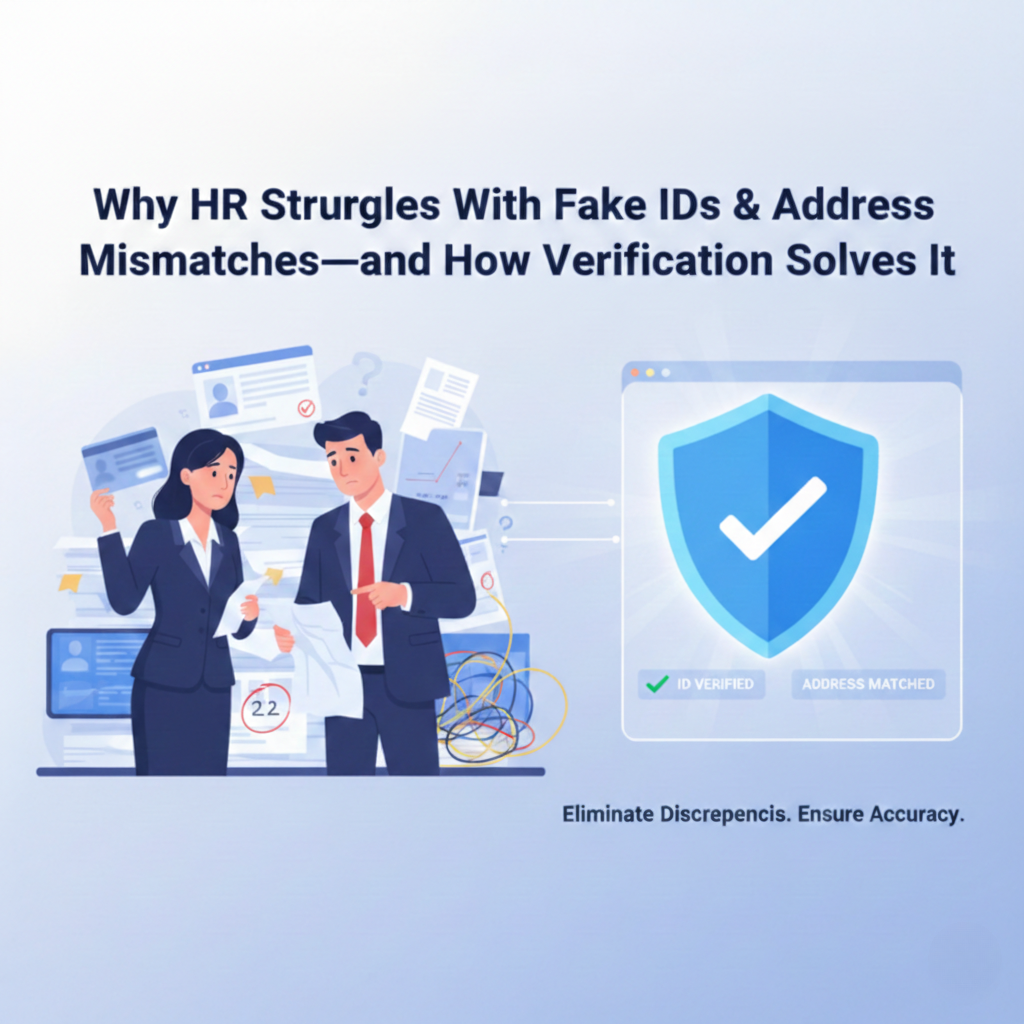
Why HR Struggles With Fake IDs & Address Mismatches and How Verification Solves It  In an era of remote hiring, global talent pools, and rapid onboarding, HR teams are under pressure to move fast. Unfortunately, speed often comes at the cost of security. Fake IDs, address mismatches, and employee impersonation are no longer rare edge cases—they’re growing risks that directly impact compliance, payroll, and organisational trust. The Growing Problem: Fake Documents in HR Onboarding HR departments increasingly encounter fake documents during the hiring process, including: Forged government-issued IDs Edited utility bills or bank statements Synthetic identities created using real and fabricated data These documents are often sophisticated enough to pass manual checks, especially when onboarding is remote. As a result, fake documents in HR workflows can slip through undetected, exposing companies to fraud, legal penalties, and reputational damage. Address Mismatches: A Hidden Red Flag Address discrepancies are one of the most overlooked indicators of identity fraud. Common issues include: IDs showing outdated or unverifiable addresses Mismatches between ID documents and tax or payroll records Addresses linked to multiple identities While these may appear to be simple data errors, they are frequently tied to employee impersonation or payroll fraud schemes. Without reliable address verification, HR teams struggle to distinguish honest mistakes from intentional deception. Why Traditional HR Checks Fall Short Many HR teams still rely on manual or semi-manual processes such as visual ID review or basic database lookups. These methods fail because they: Can’t detect high-quality forged documents Don’t validate addresses against authoritative sources Are inconsistent across locations and hiring managers Don’t scale for high-volume or global hiring As fraud tactics evolve, traditional checks simply can’t keep up. How Identity Verification Changes the Game Modern identity verification solutions use technology to close these gaps. By combining document authentication, biometric checks, and data validation, they enable HR teams to verify candidates with greater accuracy and speed. Key benefits include: Real-time detection of fake IDs using AI and forensic analysis Address verification against trusted databases and postal records Biometric matching to prevent employee impersonation Automated workflows that reduce manual errors and bias These tools not only strengthen onboarding security but also create a smoother experience for legitimate candidates. Stronger Onboarding Security, Lower Risk By integrating identity and address verification into onboarding, HR teams can: Prevent fraudulent hires before they enter the system Ensure compliance with labor, tax, and KYC regulations Protect payroll and internal systems from misuse Build trust with stakeholders and regulators In a world where digital hiring is the norm, verification is no longer optional—it’s foundational. Final Thoughts HR struggles with fake IDs and address mismatches not because of negligence, but because legacy processes weren’t designed for today’s threat landscape. Investing in robust identity verification and address verification solutions allows organizations to stay agile without sacrificing security. The result? Safer onboarding, reduced fraud, and a workforce you can trust.

bgv services in chennai for companies
Case Studies

How exit-interview analytics cut attrition by 25 in a manufacturing firm

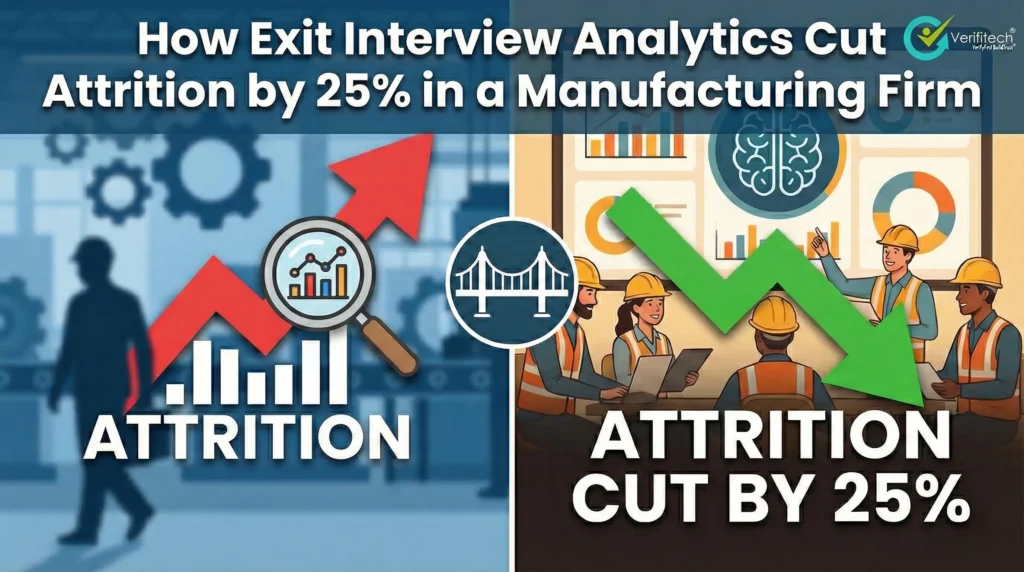
How exit-interview analytics cut attrition by 25 in a manufacturing firm  Imagine walking into your plant on a Monday morning and realizing three experienced technicians won’t be coming back. Again. You didn’t lose them to a competitor with flashy perks—you lost them quietly, one resignation at a time. If you’re in HR or leadership, this situation probably feels uncomfortably familiar. High attrition in manufacturing doesn’t just affect morale; it disrupts production schedules, inflates hiring costs, and drains hard-earned expertise.This is where an exit analytics case study, employee turnover reduction, HR insights, retention strategy becomes more than just a buzz phrase it becomes a lifeline. Understanding why employees leave is the first step toward fixing what’s broken. And when done right, exit interview analytics can turn painful goodbyes into powerful lessons that reshape your workforce strategy. The Hidden Cost of Attrition in Manufacturing: Manufacturing firms often accept attrition as “part of the industry.” Long shifts, physically demanding work, and tight margins make turnover feel inevitable. But inevitability is a dangerous assumption.In this exit analytics case study, employee turnover reduction, HR insights, retention strategy, the firm was facing a 38% annual attrition rate far above industry benchmarks. Replacements were expensive, onboarding took months, and supervisors were stretched thin. Yet exit interviews were treated as a formality. Forms were filled, files were stored, and insights were lost.The problem wasn’t a lack of data—it was a lack of analysis. Why Traditional Exit Interviews Fail: Most exit interviews ask generic questions:“Why are you leaving?”“What could we have done better?” Employees often give safe answers. “Personal reasons.” “Better opportunity.” These responses feel final but reveal very little. The firm realized that without structure and analytics, exit interviews were just polite conversations, not decision-making tools. That realization became the turning point in this exit analytics case study, employee turnover reduction, HR insights, retention strategy. Turning Conversations into Data: The HR team decided to redesign the exit process. Instead of unstructured interviews, they introduced: Standardized questionnaires with rating scales Clear categories (pay, supervision, safety, growth, work-life balance) Anonymous digital submissions to encourage honesty More importantly, they aggregated the data. Patterns began to emerge. This is where HR insights truly came alive. Over 60% of exiting employees cited shift scheduling and supervisor communication as key frustrations. Surprisingly, compensation ranked much lower than expected. The “Aha” Moment: What Employees Were Really Saying: When HR layered exit data with tenure, department, and manager-level information, the picture became clearer. Attrition wasn’t random—it was concentrated. New hires under specific supervisors were leaving within six months. Certain production lines had double the turnover of others. This exit analytics case study, employee turnover reduction, HR insights, retention strategy proved that people don’t leave companies—they leave experiences. The firm shared these findings with leadership, not as blame, but as opportunity.From Insight to Action: Building a Retention Strategy Armed with real data, the company implemented targeted changes: Supervisor training focused on communication and feedback Predictable shift rotations to reduce burnout Early check-ins at 30, 60, and 90 days for new hires       These actions weren’t expensive. They were intentional. And they were guided directly by exit analytics.                              This is the heart of any successful retention strategy—listening, learning, and acting.                         Measuring the Impact Within 12 months, attrition dropped from 38% to 28%. By the end of the second year, it reached 25%. That’s a 25% reduction in turnover—without increasing salaries across the board, In this exit analytics case study, employee turnover reduction, HR insights, retention strategy, the ROI was clear:Lower hiring and training costsImproved productivityHigher morale on the shop floorMore importantly, employees felt heard—even those who left. Why This Approach Works for You You don’t need advanced AI tools to start. What you need is commitment. Exit interview analytics work because they replace assumptions with evidence. They help you stop guessing and start fixing. If you’re struggling with churn, ask yourself: Are we actually analyzing exit data? Are we connecting insights to action? Are we using exits to protect those who stay? This exit analytics case study, employee turnover reduction, HR insights, retention strategy shows that answers are already in your organization—you just need to listen differently. Conclusion: Attrition will always exist, but unmanaged attrition is a choice. This exit analytics case study, employee turnover reduction, HR insights, retention strategy proves that when you treat exit interviews as strategic assets—not paperwork—you can transform loss into learning. By capturing honest feedback, analyzing patterns, and acting with intention, the manufacturing firm didn’t just reduce turnover by 25%. It rebuilt trust, strengthened leadership, and created a more resilient workforce. If you want real employee turnover reduction, start where the story ends—with your exits. Because every goodbye carries a lesson, and every lesson is a chance to build a stronger retention strategy for your future.

Case Studies, IT - ITES

How a Global BPO Saved 40% on Screening Costs Through Automation

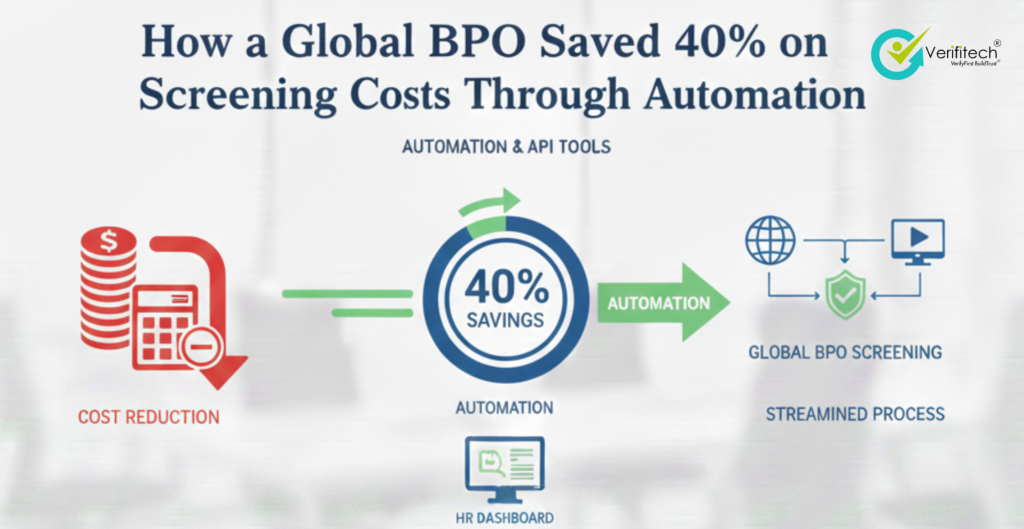
Client Overview A big company that does business operations for companies all around the world was hiring thousands of new employees every month. This company needed to do this to meet the demands of its clients. The company was growing fast.. There was a problem. The cost of checking thebackgrounds of employees was going up and it was taking a long time to verify everything. This was affecting the companys profits. How quickly it could get new employees started. The company was spending a lot of money on background checks for employees and it was taking too long to finish these checks. This was slowing down the process of getting employees on board. The company was a leading BPO with operations, in many regions and it was hiring thousands of employees every month. The Challenge The company really needed people to do a lot of things by hand. They had to depend on vendors to check things. This meant that they had problems with: High and unpredictable screening expenses Long turnaround times delaying candidate onboarding Limited visibility into verification status and costs Increased compliance and audit risks The Human Resources team and the operations team were looking for a way to do things that would work for a number of people. They wanted to find a solution that could help the Human Resources team and the operations team save money without making mistakes or breaking rules. The Human Resources team and the operations team needed this solution to be good, at keeping track of things and following the law. The Solution The BPO company put in place a computer system to check things automatically. This system brought together all the steps to check people into one process. The BPO solution made it possible to do a things. The BPO solution enabled the BPO to do these things The BPO made the whole process easier for the BPO The BPO is happy, with the system that the BPO is using. Automated identity, employment, and education verification Rule-based checks to eliminate redundant screenings Real-time dashboards for tracking progress and costs Seamless integration with existing HR systems The automation really helped to cut down on the work that people had to do and it also made sure that everything was done in the same way in all the different regions. This automation made things easier and more consistent for the automation, across all the regions. The Results Within six months of implementation, the impact was significant: 40% reduction in screening costs 65% faster verification turnaround time Improved candidate experience with real-time updates Enhanced compliance readiness with automated audit trails The results show that using BPO screening can save money. This is because the process is automated and the way it works is improved. The BPO screening savings are real. We can see them. The automated verification and smart process optimization are what make BPO screening savings happen. Business Impact The organization changed its screening process to make it more modern. This change turned background verification into a benefit for the organization of just a cost. The organization was able to get employees on board faster which helped them meet the requirements of their clients. At the time the cost of screening went down which directly improved the organizations profitability. This is an example of how the organization was able to reduce its human resources costs and it is especially useful, for companies that do a lot of hiring. The background verification process is a part of the organizations human resources and making it more efficient is a big part of reducing human resources costs. Key Takeaway Automation isn’t just about speed it’s about control, visibility, and sustainable growth. For BPOs managing high-volume hiring, automated verification can deliver meaningful cost savings without compromising trust or compliance.

Case Studies

How a FinTech Firm Cut Fraudulent Hires by 80% Using Strong ID & Criminal Checks  

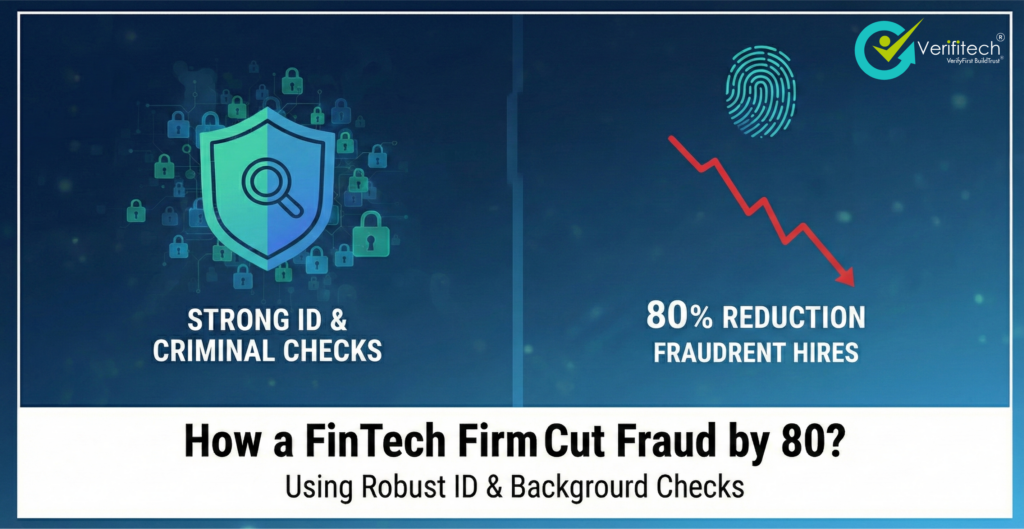
In 2024, a fast-growing FinTech company found itself facing an invisible threat—one that could collapse years of trust built with investors, regulators, and customers. Despite having a modern hiring process, they were unknowingly onboarding candidates with fabricated identities, manipulated credentials, and hidden criminal histories. What initially seemed like isolated negligence soon revealed a deeper pattern of fintech hiring fraud, putting their financial integrity and customer data at risk.HR leaders felt the pressure mounting: regulatory audits were tightening, employee vetting standards were rising, and internal teams lacked the tools to validate identities with precision. Their reputation—built on transparency and trust—was on the line. This HR compliance case study explores how a single turning point transformed their approach and why strong ID verification became the non-negotiable foundation of safe FinTech hiring. Fear-Based Narrative It began with what looked like a simple mistake. A mid-level analyst, hired during a rapid expansion cycle, was discovered submitting odd financial reports—numbers didn’t match, internal checks failed, and audit trails kept circling back to him. At first, HR assumed it was poor training. But further review unveiled something worse: the employee had been terminated from two previous companies for financial misconduct. He had concealed his history using forged documents and a cleverly fabricated ID. This wasn’t just a compliance miss—it was the wake-up call no FinTech wants. The leadership team imagined the nightmare scenario: if regulators uncovered this, it could trigger penalties in the millions. If customers found out, trust would evaporate overnight. Worst of all, the analyst wasn’t the only one. A deeper internal audit revealed that nearly 12% of new hires showed discrepancies—fake degrees, mismatched addresses, and questionable employment history.This was fintech hiring fraud in full force. The HR team realized that without a strong identity verification process, they weren’t hiring employees—they were inviting risks into the heart of their financial ecosystem. This moment became the turning point. It inspired a search for a stronger background screening partner—one capable of delivering trustworthy ID verification results and ensuring true criminal record check success. What happened next reshaped the company’s hiring standards forever. 1. Discovering the Depth of the Problem   Once the internal audit exposed the extent of fintech hiring fraud, the company launched a comprehensive review. HR, Legal, IT Security, and Compliance teams gathered to map vulnerabilities in their hiring pipeline. They found three critical gaps: This HR compliance case study quickly revealed that the company’s risk exposure was far higher than estimated. For a FinTech firm handling sensitive consumer data, the lack of verification rigor posed legal, financial, and operational threats. 2. Choosing a High-Accuracy Verification Partner   The leadership team partnered with a specialized BGV provider known for automated identity checks, API-based verification, and global database access. Their goal was to achieve measurable criminal record check success while maintaining a smooth candidate experience. The solution bundle included: This approach aligned with industry expectations for fraud prevention and helped eliminate guesswork from hiring decisions. 3. Implementing the New System   The transition unfolded in three phases: Phase 1: Integration & Training   The HR team integrated the verification platform into their ATS. Automated triggers ensured every candidate underwent identity, criminal, and document checks before shortlisting. Teams were trained on interpreting reports and escalating red flags. Phase 2: Live Screening of All New Hires   Every new candidate—regardless of seniority—went through multi-layer screening. Early results were shocking: The firm had unknowingly been on the verge of onboarding high-risk individuals again, proving the severity of fintech hiring fraud exposure. Phase 3: Retroactive Screening of Existing Workforce   This required careful execution. Over 200 employees were screened discreetly to avoid internal panic. The findings: These discoveries validated why reliable ID verification results and global database checks were essential for long-term protection. 4. Results Achieved   Within six months, the transformation was undeniable: These outcomes weren’t just operational wins—they restored leadership confidence, strengthened investor trust, and positioned the company as a compliance-first FinTech employer. Throughout the project, keywords like fintech hiring fraud, ID verification results, and criminal record check success became internal metrics. This real-world transformation is what makes this an exceptional HR compliance case study for modern FinTech firms looking to fortify their hiring process. 5. Key Lessons for the Industry   This journey offered valuable takeaways for HR and Compliance teams: By embracing these principles, any organization can replicate the same ID verification results and secure their workforce against fraud. Conclusion: This HR compliance case study proves one thing: in FinTech, trust is the currency that matters most. With rising cases of fintech hiring fraud, companies can no longer rely on traditional verification methods. Strong identity validation and thorough criminal checks aren’t just procedural—they’re transformational. For this FinTech firm, the combination of automated workflows, stringent ID verification, and global criminal screening led to remarkable outcomes: reliable ID verification results, consistent criminal record check success, and an 80% drop in fraudulent hiring attempts. Any FinTech organization seeking to protect its people, processes, and reputation can achieve similar success by strengthening their verification framework today.  

Case Studies

GST Scams and Fake Vendors: What Every Business Should Know

In India, over ₹19,690 crore of fake input tax-credit (ITC) claims were detected by the Directorate General of GST Intelligence (DGGI) in FY 2023-24 (till January alone), a surge of nearly 49% over the previous year’s ₹13,175 crore. Behind that colossal figure are hundreds of “vendors” that exist only on paper issuing invoices for no goods, no services, yet helping real buyers claim fake credits. For companies like yours and ours at Verifitech this poses a critical risk. Because when you engage a vendor who turns out to be a shell, you don’t just lose money you lose trust, face compliance scrutiny, and potentially trigger liability you never anticipated. How the Scam    Works: Let’s walk through the typical fraud chain 1: Fraudsters create a shell company that has a fake address, a bogus PAN/Aadhaar with no real operations. 2: They register under GST, get a GSTIN, and start issuing invoices showing sales of goods or services to buyers. 3: The buyer claims Input Tax Credit based on those invoices, although no genuine  supply took place. 4: Whereby, the shell disappears, or is cancelled, thus leaving the buyer exposed when the tax authorities audit. 5:The government loses out, legitimate business suffers, and confidence in the system wears down. It is a business and compliance issue, not just purely a tax one. If you purchase from a vendor who is black-listed, you may find your ITC reversed or your registration suspended, and face inquiries despite having acted in good faith. Real-World Case: When a Trusted Vendor Was a Phantom Following is a recent example to show just how subtle these schemes can get: In July 2025, the DGGI Bengaluru Zonal Unit busted a fake invoicing racket involving six shell companies. These firms had no actual business activity but generated ₹266 crore in fake invoices and enabled illegal ITC claims of around ₹48 crore. Imagine you’re a mid-sized manufacturing business: you onboard one of those vendors because they seem legitimate on paper, you take their invoices and claim the ITC — only to discover months later that the vendor was non-existent. The knock-on effect: your ITC gets reversed, the tax authorities issue notices, your working capital is tied up, and your reputation suffers. Another case: In Madhya Pradesh, criminal investigations uncovered a scam worth ₹512 crore with fake invoices and ITC of ₹130 crore, operated via over 23 shell companies and more than 150 bank accounts. These aren’t outliers. They show the lengths to which fraudsters will go, and how the victims are often legitimate businesses that simply didn’t verify their vendor adequately. The True Cost of Negligence Being taken in by a shady vendor does not just mean losing a bit of money; it might shake your business from the ground up. 1: Your tax credits can disappear: If the vendor has not filed his or her GST returns appropriately, the tax credit claimed will be invalidated. 2: You could still be fined: Even when you are completely unaware that the vendor was fake, the liability usually falls on you. 3:You might attract unwanted checks: Whenever something doesn’t look right, the tax department opens an audit or even holds up your GST number. 4:Your reputation is compromised: If your name happens to appear in association with a fake invoice, then it becomes difficult to win back clients’, auditors’, or investors’ trust. It takes only one bad partnership to often undo years of great effort-not because you broke the law, but because you didn’t see the red flags in time. In short, a fake vendor doesn’t just cheat the system, they quietly damage every business that touches their invoice trail. How Verification Protects You Verification isn’t just paperwork, it’s your early warning system. a): When done right, it helps you identify inconsistencies such as vendors with unmatched GST returns or non-filers. b:) Confirm business legitimacy by checking address, ownership, and activity before collaboration. c:) Avoid shared liability     ensuring your ITC claims are clean and traceable. d:) Establish trustworthy partnerships because a due diligence process drives honest trust in the supply chain. Think of it this way:  A five-minute verification step can save months of legal headaches and financial   uncertainty later.  The Larger Picture  The Centre has introduced AI-driven checks, e-invoicing, and analytics to track fraud,   but most of these measures react after the scam is committed.That’s why every   company, big or small, needs to create a culture of verification, rather than just   compliance. When every organization takes responsibility in vetting who they work with, the space  for fraud is reduced naturally. Invoices may be convincing, but no fraud stands the test of scrutiny. Before you trust a vendor, stop and check. Because in today’s business world, trust is not immediate-it’s earned through verification. References: Indianexpress.com/articles

Balancing Innovation and Integrity in Justice
Case Studies, Others

 AI in Judiciary: Why Courts Are Being ‘Cautious’ 

 AI in Judiciary: Why Courts Are Being ‘Cautious’  Can AI Write a Court Order?  What Bengaluru’s Strange Case Teaches Us About Responsible TechnologyWhen Machines Obey, But Humans Forget to Lead. A few months ago, the idea of AI drafting a court order would have sounded absurd, something straight out of a sci-fi movie. But in Bengaluru, that’s exactly what happened. The Income Tax Appellate Tribunal (ITAT) discovered that an order had been written using artificial intelligence. When the case reached the Karnataka High Court, judges called it “an extraordinary instance.” Not because the machine went rogue but because humans allowed it to happen.The question isn’t “Can AI write a court order?” It’s “Why did someone let it?”  When Convenience Replaces Caution  AI was built to assist human judgment, not replace it. But somewhere in our pursuit of convenience, we began to forget where assistance ends and dependence begins. In this Bengaluru case, it wasn’t the machine making a choice. It was a person deciding that a task meant for a judge could be handled by a tool. Maybe it was an innocent shortcut. Maybe it was negligence. But it revealed something big and deep. How easily we allow convenience to take the place of caution. The problem isn’t with AI. It’s that people who misuse power without responsibility.And Mistakes become ethical catastrophes when technology is used as a way to avoid human accountability.  A Case that reflects everyday choices  Imagine a taxpayer who has been anxiously awaiting a decision that could affect their future for months.When it does come, the language is clear and the logic remains sound but something feels odd. It wasn’t written by a person. It was written by a program. No empathy. No context. No understanding of what that decision truly meant. That isn’t an AI failure.It’s a human one. And this pattern extends far beyond the courtroom. From hiring to compliance, from finance to verification — AI now quietly shapes decisions that touch real lives. Every report and algorithm has a person at its core, whose future could be altered by a single click. A biassed dataset, a single incorrect input, or a moment of human error can wrongfully harm someone’s reputation or turn down them an opportunity they deserve. In reality, technology is not biassed.The true risk, however, is in those who create it, train it, or abuse it. People, Not Just Algorithms, Are Needed for Trust AI lacks empathy and transparency, but it can think quickly. As a result, trust comes from responsible humans, not from machines.No matter how sophisticated, a system is only as reliable as its users. That where Background Verifications are essential because they verify that people using sensitive information or powerful tools are not only competent but also ethical, responsible, and reliable. Because technology doesn’t misuse itself. That choice is made by the people. Moreover, the first step to avoid technology misuse is to make sure the right people are in the right roles. The Bengaluru case isn’t a warning against AI. It’s a wake up call for us. Before questioning what machines can do, we must question who is using them and how.  What’s your take?  Should AI misuse be blamed on the tool or the people behind it?

Soham Parekh’s confession highlights why startups must prioritize background verification to avoid costly hiring mistakes.
Case Studies

Soham Parekh’s confession highlights why startups must prioritize background verification to avoid costly hiring mistakes

Soham Parekh’s Candid Confession: Balancing Multiple Startups Was a Mistake – A Wake-Up Call for Background Verification   In the fast-paced world of startups, it might seem like the best way to get things done is to work on more than one project at a time. But for Soham Parekh, a young entrepreneur with a string of promising startups under his belt, it was a warning about how ambition can get in the way of focus. This case study looks at how Soham’s businesses were affected by him having to juggle multiple roles, what went wrong, and what founders and teams can learn from his experience.   “I’m not proud of what I’ve done. Trying to balance multiple startups was a mistake.”   The Background   Soham Parekh started his first business in the fintech space when he was 23 years old. Over the next five years, he helped start three more companies in the fields of healthtech, e-commerce, and SaaS. He was also a key player in all three. Each business had good ideas, committed teams, and interest from investors at the start. He was the poster child for hustle culture. But beneath the surface, cracks were forming: Soham missed important deadlines because he was overcommitted. Growth has stalled, according to two startups. Internal teams pointed to poor resource management and a lack of leadership. The Fallout: When Ambition Becomes Liability   Soham’s confession turned into a case study of a failure to exercise due diligence, not just a personal admission. When operations collapsed, employees faced layoffs, and investors lost over $10 million in withdrawn funding. Public trust was undermined by negative press, which hurt brand reputations. This wasn’t merely a leadership error. A systemic oversight occurred when important leadership positions were not checked and monitored.   How It Could Have Been Avoided with Background Verification Contemporary BGV isn’t limited to entry-level employees. It is essential for risk mitigation at the leadership level.   A thorough BGV procedure would have shown the following:   Detection of Employment Overlap: locating concurrent CXO positions in rival startups. Checks for Conflicts of Interest: pointing out unreported advisory positions that might divert attention. Media and Social Reputation Screening: Online forums show early indications of investor concerns and team dissatisfaction. Compliance and Litigation Checks: ongoing disagreements between Soham’s businesses regarding intellectual property. Verification of Financial Integrity: disparities in ownership structures and unexplained changes in equity holdings. Investors and boards might have avoided operational and reputational harm if they had used these insights to inform their decisions.   The Tipping Point: Industry Acquires Knowledge the Hard Way   After Soham came clean, VC firms required BGV for all leadership hires prior to investment, startups implemented continuous monitoring for advisors and CXOs, and Soham’s remaining businesses implemented stringent governance procedures and collaborated with expert BGV agencies to restore confidence.   Important Organizational Lessons 1. Leadership Verification Is Non-Negotiable – Senior hires have the ability to make or break a business. Comprehensive BGV guarantees that their performance history is consistent with your principles. 2. Look Past LinkedIn and Resumes – Public profiles frequently highlight achievements while concealing operational flaws and disputes. Verification by a third party goes further. 3. Constant Monitoring Is Essential – After onboarding, leadership risks continue. Future liabilities are avoided through ongoing checks. 4. Safeguard Employees, Investors, and Brand Image – A strong BGV protects against monetary loss and damage to one’s reputation.   Conclusion: The startup ecosystem needs to wake up. The story of Soham Parekh highlights a harsh reality: “Trust is hard to restore once it’s lost.” However, if the proper mechanisms are in place, it can be protected. As companies grow, their leaders need to be carefully screened for compliance, integrity, and focus in addition to skills.   Background verification is no longer optional. It’s a strategic imperative. Leave comments on this post

Scroll to Top
Consent Management Platform by Real Cookie Banner